
How sleep affects fat loss is something many people overlook. You might exercise regularly, eat healthy meals, avoid junk food, and still struggle to lose weight. This can feel frustrating and confusing.
What if I tell you that the missing piece in your fat loss journey is not your diet or workout plan, but your sleep?
Many people solely focus on food and exercise when thinking about sleep and weight loss. However, fat loss and sleep are deeply interconnected. Without enough sleep, your body struggles to reduce or burn fat properly. Let’s explore how sleep affects fat loss in simple and clear terms.
The Link Between Sleep and Metabolism
Your metabolism is the process your body uses to turn food into energy. When you sleep well, your metabolism works smoothly. When you don’t, everything slows down.
Poor sleep can reduce the number of calories your body burns at rest. This means even if you are eating the same amount of food, your body may store more of it as fat instead of using it for energy. That’s why metabolism and sleep go hand in hand.
When you are sleep-deprived:
- Your body tries to conserve energy.
- You feel more tired and less active.
- You burn fewer calories during the day.
Over time, this makes fat loss much harder.
How Hormones Control Hunger and Fat Storage
Your body uses hormones to control hunger, fullness, stress, and blood sugar. Sleep plays a major role in keeping these hormones balanced.
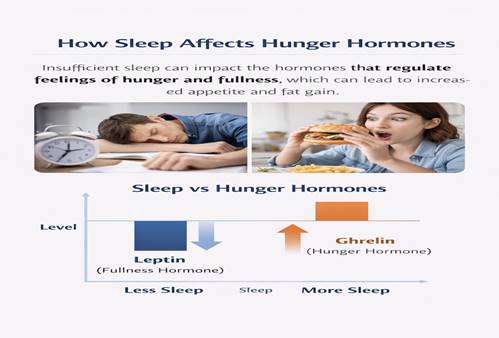
1. Ghrelin – The Hunger Hormone
Ghrelin tells your brain that you are hungry. When you do not sleep enough, ghrelin levels increase. This made you feel hungrier than usual, even if your body does not need food.
2. Leptin – The Fullness Hormone
Leptin tells your brain that you are not hungry. A drop in sleep time lowers leptin levels. This means you may keep eating because your brain does not receive the “I’m full” signal properly.
This combination—high ghrelin and low leptin—leads to stronger cravings, especially for sugary and high-calorie foods.
3. Cortisol – The Stress Hormone
When you are tired, your body feels stressed. Cortisol levels rise. High cortisol and fat storage are directly proportional to each other, especially around the belly area. It also increases emotional eating, where you eat to feel comfort instead of hunger.
4. Insulin – Blood Sugar Control
Insulin helps control blood sugar. Poor sleep can make your body less sensitive to insulin. When this happens, your body stores more fat and struggles to use sugar for energy.
Together, these hormone changes clearly show how sleep affects fat loss. Even one week of poor sleep can increase appetite and slow down progress.
Poor Sleep Reduces Workout Results
You may think, “I’ll just work out harder.” But lack of sleep makes that very difficult.
When you are tired:
- Your energy levels dip and drop.
- Your workout performance also drops.
- You may skip exercise fully.
- Your muscle recovery rate slows down.
Without proper sleep, your body cannot repair muscle tissue effectively. Muscle helps burn calories, so slower recovery can decrease your fat-burning capabilities. Fat loss and sleep are so closely linked because when you rest, your body repairs and rebuilds.
Why Sleep Encourages Fat Burning
During deep sleep, growth hormones are released by your body. This hormone supports muscle repair and fat burning. If you cut your sleep time short, you are reducing this important process.

Good sleep also:
- Lowers stress levels
- Balances hunger hormones
- Improves insulin sensitivity
- Increases your energy level for daily activity
All of this supports healthy sleep and weight loss naturally.
6 Practical Tips to Improve Sleep for Better Fat Loss
Improving your sleep does not require or demand complicated changes. Small habits can make a great amount of difference.
- Go to bed and wake up at the same time every day.
- Avoid using phones, tablets, or laptops at least one hour before bed.
- Limit caffeine in the evening.
- Create a dark, quiet, and cool sleeping environment.
- Avoid heavy meals right before bedtime.
- Try relaxing activities like reading or deep breathing.
These simple steps can improve metabolism and the quality of your sleep over time.
Final Thoughts: Make Sleep a Priority
If you have been working hard but not getting the expected results, do not blame yourself. It is simple that your body requires more rest time. Understanding how the fact that sleep affects fat loss can completely change your approach toward it.
Sleep is not laziness. It is a powerful tool or weapon for fat burning, hormone balance, and overall health. Starting tonight, targeting 7–9 hours of quality sleep. Treat sleep as an important workout session.
Your body heals, balances, and burns fat while you rest. Give importance or prioritize sleep, stay consistent, and give yourself the best chance to succeed on your fat loss journey.
According to research from the National Sleep Foundation, adults should get 7–9 hours of sleep for optimal health.
https://www.health.harvard.edu
FAQs
Does sleep help burn fat?
Yes. During deep sleep, the body releases growth hormone that helps repair muscle and burn fat.
How many hours of sleep help with weight loss?
Most adults need 7–9 hours of quality sleep for proper metabolism and hormone balance.
Leave a Reply