INTRODUCTION: WHY MOST PEOPLE NEVER BUILD MUSCLE
Muscle building is a structured process that requires training, nutrition, and recovery working together.
Every year, millions of people join gyms with the same goal:
- gain muscle
- build strength
- transform their body

But after a few months, most of them quit or stay stuck with almost no visible change.
Not because they are lazy.
Not because they lack genetics.
But because they misunderstand how muscle building actually works.
Muscle building is not a workout plan. It is a biological adaptation system that only works when training, nutrition, and recovery are aligned consistently over time.
Most people focus only on training and ignore the rest.
That’s where failure begins.
1. WHAT IS MUSCLE BUILDING REALLY?
Muscle building is scientifically known as muscle hypertrophy.
In simple terms:
When you apply resistance (weights or bodyweight training), your muscle fibers experience controlled damage.
Your body then responds by:
- repairing those fibers
- increasing their thickness
- making them stronger for future stress
That adaptation process is called muscle growth.
IMPORTANT TRUTH
You do NOT build muscle in the gym
You build muscle after the gym
Gym = stimulus
Recovery = growth
THE MUSCLE BUILDING CYCLE
Muscle growth happens in three stages:
1. Training (Stress Phase)
- weights create tension
- Muscle fibers break slightly
- The body receives a “growth signal.”
2. Nutrition (Repair Phase)
- Protein provides amino acids
- calories fuel recovery
- nutrients rebuild tissue
3. Recovery (Growth Phase)
- muscle fibers repair stronger
- Hormones regulate growth
- adaptation happens
2. WHY MOST PEOPLE FAIL AT MUSCLE BUILDING
Around 90% of people fail not because of genetics, but because of poor system design.
Let’s break it down:
1. No Progressive Overload
They lift the same weight for months.
No increase, no adaptation, no growth
2. Random Training
Every session is different.
No structure → no progression tracking.
3. Poor Nutrition
Low protein intake + inconsistent calories.
No building material for muscles
4. Inconsistency
Training for a few days, then breaks.
The body never adapts fully
5. Ignoring Recovery
Poor sleep + no rest days.
The muscle repair process breaks down
3. BASIC SCIENCE OF MUSCLE GROWTH
The key process behind muscle building is
Muscle Protein Synthesis (MPS)
This is the process where the body builds new muscle tissue.
SIMPLE RULE:
- If MPS > muscle breakdown → muscle grows
- If MPS < muscle breakdown → no growth
WHAT CONTROLS MPS?
- Protein intake
- Training intensity
- Sleep quality
- Calorie surplus
4. TRAINING, THE GROWTH SIGNAL
Training does not build muscle directly.
It sends a signal:
“This muscle needs to become stronger.”
That’s it.
PROGRESSIVE OVERLOAD (MOST IMPORTANT PRINCIPLE)
Muscles only grow when stress increases over time.
Ways to apply it:
- increase weight
- increase reps
- increase sets
- improve form and control
SIMPLE EXAMPLE:
Week 1: 40kg bench press × 10 reps
Week 3: 45kg bench press × 10 reps
That is a real growth stimulus.
Now we move deeper into the practical system:
How exactly should you actually train to build muscle?
Because without a structured training system, even the best motivation fails.
1. TRAINING IS NOT RANDOM; IT IS STRUCTURED
Most beginners think muscle building is just
- going to the gym
- lifting some weights
- doing random exercises
But real muscle growth requires structure.
Training is not about doing more; it is about doing the right things consistently.
2. PROGRESSIVE OVERLOAD (DETAILED UNDERSTANDING)
We already introduced this concept, but now let’s go deeper.
Progressive overload means the following:
Gradually increasing the demand placed on your muscles over time.
WHY IT WORKS
Your body adapts to stress.
If the stress never increases:
The body has no reason to grow
WAYS TO APPLY PROGRESSIVE OVERLOAD
1. Increase Weight
Example:
- Week 1: 40kg bench press
- Week 3: 45kg bench press
2. Increase Reps
Example:
- 10 reps → 12 reps → 15 reps
3. Increase Sets
Example:
- 3 sets → 4 sets
4. Improve Form & Range
- deeper squat
- slower controlled reps
- better muscle engagement
COMMON MISTAKE
Most people stay at the same level for months.
No overload, no growth
3. BEST TRAINING SPLITS FOR MUSCLE BUILDING
A training split is how you organize your workouts weekly.
FULL BODY WORKOUT (BEGINNERS)
Structure:
- Train the entire body in one session
- 3 days per week
Example:
- Squats
- Bench press
- Rows
- Shoulder press
Advantages:
- fast adaptation
- good for beginners
- frequent muscle stimulation
Disadvantages:
- less focus per muscle
- fatigue builds quickly
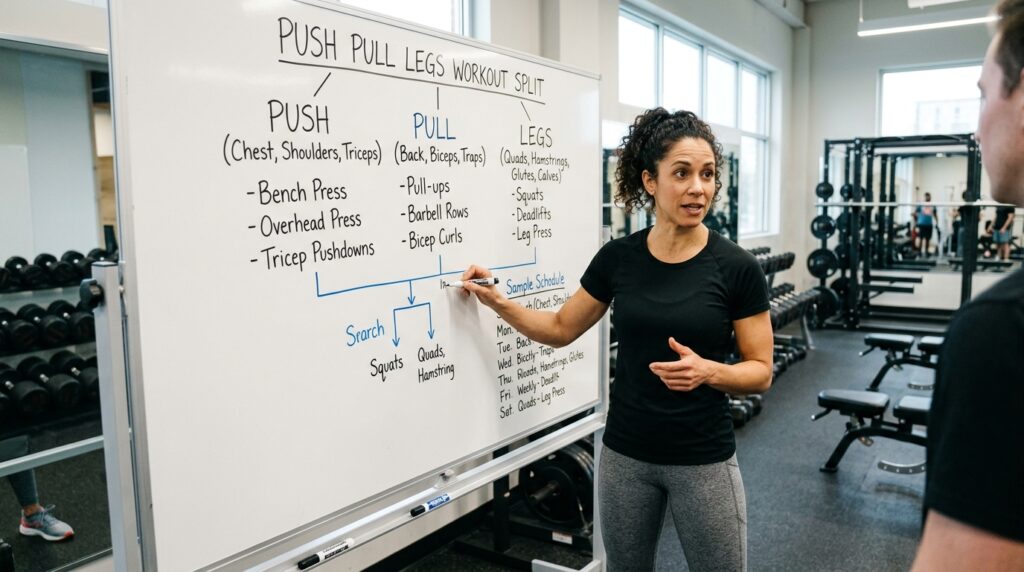
PUSH PULL LEGS (BEST OVERALL SYSTEM)
This is one of the most effective systems for muscle building.
PUSH DAY
- chest
- shoulders
- triceps
PULL DAY
- back
- biceps
LEGS DAY
- quads
- hamstrings
- calves
Advantages:
- balanced recovery
- scalable for all levels
- efficient muscle targeting
UPPER / LOWER SPLIT
Upper Day:
- chest, back, shoulders, arms
Lower Day:
- legs + glutes
Advantages:
- balanced frequency
- Good for intermediate lifters,
- better recovery than full body
4. COMPOUND VS. ISOLATION EXERCISES
Understanding this is critical for muscle building.
COMPOUND EXERCISES (MAIN BUILDERS)
These involve multiple muscle groups.
Examples:
- Squats
- Deadlifts
- Bench Press
- Pull-ups
- Overhead Press
WHY THEY MATTER:
- build maximum muscle mass
- increase strength
- activate multiple muscles together
ISOLATION EXERCISES
These target single muscles.
Examples:
- Bicep curls
- Triceps pushdowns
- Lateral raises
- Leg extensions
PURPOSE:
- improve muscle shape
- fix weak points
- refine aesthetics
GOLDEN BALANCE RULE
70% compound exercises
30% isolation exercises
5. COMMON TRAINING MISTAKES
1. EGO LIFTING
Lifting heavy things with bad form is dangerous.
leads to injury + poor muscle activation
2. RANDOM WORKOUTS
No plan, no structure.
no long-term progression
3. OVERTRAINING
More is not better.
The recovery gets damaged
4. NO TRACKING
No record of weights or reps.
progress becomes invisible
5. CONSTANT PROGRAM CHANGING
Switching routines every week.
The body never adapts
6. REALISTIC TRAINING COMPARISON
PERSON A (STRUCTURED TRAINING)
- follows push-pull legs
- tracks progressive overload
- follows a consistent routine
Result after 12 weeks:
- visible muscle growth
- improved strength
- better body composition
PERSON B (RANDOM TRAINING)
- changes exercises daily
- no tracking
- inconsistent effort
Result:
- almost no visible change
KEY INSIGHT
Same gym. At the same time. Completely different results.
The difference is structure, not effort.
1. WHY NUTRITION IS 50% OF MUSCLE BUILDING
Muscle building is often misunderstood as a process that only occurs in the gym.
But in reality:
- Gym = stimulus (breaks muscle fibers)
- Food = construction material (rebuilds muscle)
If you remove nutrition, your body has nothing to rebuild with.
That is why some people train for months and still look the same.

2. CALORIE SURPLUS (FOUNDATION OF MUSCLE GAIN)
To build muscle, your body needs extra energy.
This is called a calorie surplus.
SIMPLE DEFINITION
You must eat:
More calories than your body burns daily
WHY IT WORKS
Muscle growth is an energy-demanding process.
Your body needs:
- energy for training
- energy for recovery
- energy for new muscle tissue
Without extra calories:
The body will not build new tissue efficiently
EXAMPLE
- Maintenance calories: 2500/day
- Muscle gain intake: 2800–3000/day
Result: controlled muscle growth environment
IMPORTANT BALANCE
- Too few calories → no muscle gain
- Too many calories → fat gain
Ideal surplus:
+250 to +400 calories/day
3. PROTEIN (MOST IMPORTANT NUTRIENT)
Protein is the building block of muscle.
Without protein:
- no repair
- no recovery
- no growth
HOW MUCH PROTEIN DO YOU NEED?
1.6 g to 2.2g per kg body weight
EXAMPLE
If you weigh 70kg:
- Minimum: 112g protein/day
- Optimal: 130–150g/day
BEST PROTEIN SOURCES
Animal sources:
- Chicken
- Eggs
- Fish
- Milk
- Yogurt
Plant sources:
- Lentils (daal)
- Chickpeas
- Beans
- Soy products
COMMON MISTAKE
Most beginners think:
“I eat a lot, so protein is enough.”
But:
Calories ≠ Protein
You can eat high calories and still have low protein.
4. CARBOHYDRATES (TRAINING FUEL)
Carbs are not the enemy.
They are your performance fuel.
WHY CARBS MATTER
Carbohydrates:
- fuel workouts
- improve strength
- increase training volume
- support recovery
BEST CARB SOURCES
- Rice
- Oats
- Potatoes
- Whole wheat bread
- Fruits
LOW CARB ISSUE
If carbs are too low:
- energy drops
- Workouts feel weak
- strength decreases
- muscle gain slows
5. FATS (HORMONE SUPPORT SYSTEM)
Fats play a critical role in muscle building.
They are NOT bad.
WHY FATS ARE IMPORTANT
- support testosterone production
- improve hormone balance
- support joint health
- provide long-term energy
GOOD FAT SOURCES
- eggs yolk
- nuts
- olive oil
- peanut butter
- avocado
6. SUPPLEMENTS (REALITY, NOT MARKETING)
Supplements are often overhyped.
But the truth is simple:
Supplements support progress — they do NOT create progress.
WHEY PROTEIN
- convenient protein source
- helps hit daily protein target
- not mandatory
CREATINE
One of the most researched supplements.
Benefits:
- increases strength
- improves performance
- enhances recovery
OTHER SUPPLEMENTS
- BCAA → unnecessary if protein is sufficient
- Mass gainers → only useful if you can’t eat enough
TRUTH
Supplements = 5–10% role
Diet + training = 90% results
7. REAL MUSCLE BUILDING DIET STRUCTURE
A simple and effective daily structure:
BREAKFAST
- eggs
- oats
- milk
LUNCH
- chicken or beef
- rice
- vegetables
SNACK
- banana
- peanut butter
- yogurt
DINNER
- lentils or chicken
- roti or rice
- salad
BEFORE BED
- milk or yogurt
Simple, repeatable, effective.
8. COMMON NUTRITION MISTAKES
1. NOT TRACKING CALORIES
Guessing leads to inconsistency.
2. LOW PROTEIN INTAKE
No building material = no muscle growth.
3. DIRTY BULKING
Eating junk food, thinking it builds muscle.
Result: fat gain only
4. SKIPPING MEALS
Breaks calorie surplus consistency.
5. RANDOM DIET CHANGES
No system = no adaptation.
9. REAL COMPARISON: GOOD VS BAD NUTRITION
GOOD NUTRITION
- consistent calorie surplus
- high protein intake
- balanced carbs and fats
- structured meals
Result:
steady muscle gain + strength improvement
BAD NUTRITION
- random eating
- low protein
- inconsistent calories
- junk food dependency
Result:
no visible muscle change
10. KEY TAKEAWAY
Nutrition is not about eating more.
It is about eating:
correctly, consistently, and with purpose
Without it:
Training has no result
With it:
training becomes powerful
Now we move to the most ignored but most powerful factor:
Recovery + real scientific validation of muscle building
Because muscle is NOT built in the gym or kitchen alone.
It is built during recovery.
1. RECOVERY, WHERE MUSCLE GROWTH ACTUALLY HAPPENS
When you train, you create microscopic damage in muscle fibers.
But growth does not happen during that damage.
It happens AFTER it.
WHAT RECOVERY ACTUALLY DOES
During recovery:
- Damaged muscle fibers are repaired
- protein synthesis increases
- nervous system resets
- Strength capacity improves
- muscle thickness increases
This is the actual “growth phase.”
CRITICAL TRUTH
Training stimulates growth
Recovery executes growth
Without recovery:
Training becomes damaging without benefit
2. SLEEP (THE MOST ANABOLIC TOOL)
Sleep is the most powerful natural muscle-building mechanism.
SCIENTIFIC INSIGHT
Research shows that muscle protein synthesis and hormonal recovery are significantly improved during deep sleep cycles, especially growth hormone release during slow-wave sleep.
This is why poor sleep directly reduces muscle gain potential.

IDEAL SLEEP RANGE
- 7–9 hours per night
- consistent sleep timing
- deep uninterrupted sleep
POOR SLEEP EFFECTS
- reduced strength
- slower recovery
- increased fatigue
- reduced testosterone levels
- poor workout performance
3. OVERTRAINING PROBLEM (GROWTH DESTROYER)
More training does NOT equal more muscle.
This is one of the biggest myths in fitness.
WHAT OVERTRAINING DOES
- increases cortisol (stress hormone)
- reduces recovery speed
- lowers performance
- breaks the consistency cycle
SIGNS OF OVERTRAINING
- constant soreness
- strength decrease
- lack of motivation
- poor sleep
- no visible progress
REALITY
Muscle grows when recovery > stress
Not when stress > recovery
4. SCIENTIFIC RESEARCH BACKING MUSCLE GROWTH
Now, let’s validate muscle building with real scientific findings.
1. PROTEIN & MUSCLE GROWTH
A meta-analysis published in sports nutrition research shows that higher protein intake significantly improves muscle mass and strength gains during resistance training.
Source summary:
Protein supplementation increases fat-free mass and muscle hypertrophy when combined with resistance training.
Key insight:
Protein only works effectively when paired with resistance training.
2. PROTEIN REQUIREMENT RANGE
Research shows optimal muscle growth occurs around:
1.6 g to 2.2g protein per kg body weight
Higher intake beyond this range shows minimal additional benefit for most individuals.
3. PROTEIN TIMING MYTH
Many believe protein timing (post-workout window) is critical.
However, meta-analysis research indicates:
Total daily protein intake is more important than timing.
KEY SCIENTIFIC CONCLUSION
Muscle growth depends more on total daily consistency than perfect timing strategies.
REAL CASE STUDIES (PRACTICAL EXAMPLES)
Now let’s connect science with real-world outcomes.
CASE STUDY 1: STRUCTURED ATHLETE
Profile:
- age: 24
- training experience: beginner
- goal: lean muscle gain
Strategy:
- Push-Pull-Legs routine
- 300-calorie surpluses
- 140g protein daily
- 8 hours of sleep
Result after 12 weeks:
- +4.5 kg lean muscle gain
- visible body transformation
- Strength increases in all lifts
Key factor: consistency + structured system
CASE STUDY 2: RANDOM TRAINER
Profile:
- same age group
- similar starting body
Strategy:
- random workouts
- no diet tracking
- inconsistent sleep
Result after 12 weeks:
- minimal muscle change
- fatigue issues
- no strength progression
Key factor: lack of structure
COMPARISON INSIGHT
Same body type. Same gym access. Same time period.
Completely different outcomes due to system quality.
6. WHY MOST PEOPLE STAY STUCK
Muscle-building failure usually comes from:
1. IMPATIENCE
Expecting results in 2–3 weeks.
2. RANDOM APPROACH
No fixed training or diet system.
3. INCONSISTENCY
Starting and stopping repeatedly.
4. RECOVERY IGNORANCE
Poor sleep and no rest planning.
5. INFORMATION OVERLOAD
Changing programs too often.
7. REAL MUSCLE-BUILDING FORMULA
After all, science + practice:
Muscle Growth = Training Stimulus + Nutrition Surplus + Recovery Adaptation + Time
If even one is missing:
progress slows or stops
Now we go one level deeper.
Because once the basics are understood, the real challenge begins:
Why do people still stop growing even when they are training and eating correctly?
The answer lies in adaptation, plateaus, and advanced training understanding.
1. THE BODY’S ADAPTATION PROBLEM
The human body is extremely intelligent.
It does not grow just because you are training hard.
It grows only when it is forced to adapt.
But here is the catch:
The body adapts to everything over time.
WHAT THIS MEANS
If you do the same workout repeatedly:
- same weights
- same reps
- same exercises
- same intensity
Your body becomes efficient at it
And when efficiency increases:
growth decreases
SIMPLE TRUTH
Muscle growth only happens when:
The body is forced out of its comfort zone
Not slightly.
Not occasionally.
But repeatedly over time.
2. WHAT IS A MUSCLE-BUILDING PLATEAU?
A plateau is a phase where
- Strength stops increasing
- muscle size stops changing
- Performance feels “stuck.”
- motivation drops
WHY PLATEAUS HAPPEN
There are only a few real reasons:
1. ADAPTATION COMPLETE
Your body is fully adapted to your current routine.
2. NO NEW STIMULUS
Same workout = same stress = no new growth signal.
3. RECOVERY LIMITATION
You are training, but not recovering enough.
4. NUTRITION STAGNATION
No increase in calories or protein over time.
IMPORTANT TRUTH
Plateaus are NOT failures
They are signals that your system needs progression
3. TRAINING INTENSITY VS. TRAINING VOLUME
Most people confuse these two.
TRAINING VOLUME
This means:
- total sets
- total reps
- total workload
Example:
3 sets × 10 reps × multiple exercises
TRAINING INTENSITY
This means:
- how hard each set is
- How close you go to failure
- How much effort per rep
KEY INSIGHT
You don’t always need more volume.
Sometimes you need:
more intensity
better control
better execution
BALANCE RULE
- Beginners: moderate volume + learning from
- Intermediate: balanced volume + intensity
- Advanced: higher intensity + controlled volume
4. MUSCLE FIBER TYPES (IMPORTANT BUT IGNORED)
Muscles are not all the same.
They consist of different fiber types.
TYPE I (SLOW TWITCH)
- endurance-based
- resistant to fatigue
- activated in long sets
Example: walking, light reps
TYPE II (FAST TWITCH)
- high power output
- responsible for size and strength
- grows the most in hypertrophy training
Example: heavy lifting, explosive reps
KEY POINT
Muscle building mainly targets fast-twitch fibers
That is why:
- heavy lifting
- progressive overload
- resistance training
are essential.
5. FAILURE TRAINING (WHY IT MATTERS)
Training to failure means the following:
performing reps until you cannot complete another rep with proper form
WHY IT WORKS
It:
- recruits maximum muscle fibers
- increases stimulus intensity
- forces adaptation
BUT THERE IS A LIMIT
Training to failure:
- every set = overtraining risk
- reduces recovery ability
- increases fatigue accumulation
SMART APPROACH
- not every set to failure
- Last set of exercises sometimes
- controlled intensity progression
6. REALISTIC MUSCLE GROWTH TIMELINE
Many people expect fast results.
But real muscle growth follows a slow curve.
0–4 WEEKS
- neural adaptation
- Strength improves slightly
- body “learns” movements
- Visual change is minimal
4–12 WEEKS
- visible muscle changes start
- Strength increases clearly
- body shape improves
3–6 MONTHS
- noticeable transformation
- improved muscle density
- better aesthetics
6–12 MONTHS
- full-body recomposition possible
- major strength improvements
- clear physique change
KEY TRUTH
Muscle building is not fast, but it is predictable
7. WHY SOME PEOPLE GROW FASTER THAN OTHERS
Even with the same program, results differ.
FACTORS THAT MATTER:
1. CONSISTENCY
More consistent = faster progress
2. GENETIC RESPONSE
Some people respond faster to training stimuli.
3. RECOVERY QUALITY
Better sleep equals faster growth
4. NUTRITION PRECISION
Accurate calorie and protein intake matters
FINAL INSIGHT
The difference is not effort; it is the quality of execution over time
Now we move into something even more important for long-term success:
How to keep growing for years without getting injured or burned out
Because most people don’t fail in the first 3 months…
They fail after 6–12 months when injuries, boredom, or inconsistency appear.
MUSCLE BUILDING IS A LONG-TERM GAME
Muscle building is not a 30-day challenge.
It is a multi-year adaptation process.
Your body is constantly
- adapting
- recovering
- strengthening
- resisting stress
So, the real goal is not just “gain muscle fast.”
It is:
Gain muscle consistently without breaking your body
WHY INJURIES STOP MOST PEOPLE
One injury can destroy months of progress.
Not because muscle disappears…
But because:
- training stops
- consistency breaks
- confidence drops
- momentum is lost
MAIN CAUSES OF INJURY
1. Ego lifting
Trying to lift more weight than your form allows.
2. Poor warm-up
Jumping directly into heavy sets without preparing joints and muscles.
3. Ignoring form
Focusing on weight instead of movement control.
4. Overuse
Doing the same movement patterns repeatedly without variation or rest.
KEY TRUTH
Injury does not come from training
It comes from poor control of training
PROPER WARM-UP SYSTEM (UNDERRATED FACTOR)
Warm-up is not optional.
It is a performance + injury prevention tool.
GOOD WARM-UP STRUCTURE
Step 1: Light cardio (5–10 min)
- walking
- cycling
- light jogging
Step 2: Joint mobility
- shoulder rotations
- hip movements
- dynamic stretches
Step 3: Gradual loading
Start light → slowly increase weight before working sets
THIS MATTERS
Warm-up:
- increases blood flow
- improves joint lubrication
- activates the nervous system
- improves performance
LONG-TERM PROGRESSION THINKING
Most beginners think in weeks.
Advanced lifters think in years.
BEGINNER MINDSET
- “I want fast results.”
- “Why am I not growing in 2 weeks?”
- “Should I change my program?”
ADVANCED MINDSET
- “Am I stronger than last month?”
- “Am I recovering properly?”
- “Am I consistent over time?”
KEY SHIFT
Muscle building rewards patience, not speed
PROGRESSION OVER YEARS (REALISTIC MODEL)
Muscle growth is not linear.
It looks like this:
YEAR 1
- Fastest gains (beginner phase)
- Strength improves rapidly.
- The body responds quickly
YEAR 2
- slower progress
- requires more structure
- nutrition becomes critical
YEAR 3+
- very slow but steady gains
- advanced programming required
- recovery becomes priority
IMPORTANT TRUTH
The longer you train, the harder growth becomes, but also more meaningful
MINDSET OF SUCCESSFUL LIFTERS
The difference between average and advanced lifters is not physical…
It is mental.
SUCCESSFUL LIFTER THINKING
- Consistency matters more than motivation
- Little progress is still progress
- Recovery is part of training
- Plateaus are normal
- Discipline beats intensity
AVERAGE LIFTER THINKING
- needs motivation every time
- changes programs too often
- focuses only on short-term results
- quits during plateaus
CORE TRUTH
Your body changes when your behavior becomes stable
BALANCE BETWEEN TRAINING, LIFE & RECOVERY
Many people destroy progress by ignoring balance.
TRAINING SIDE
- 4–6 days/week is enough
- quality > quantity
- Recovery days are required
LIFE SIDE
- stress management matters
- Sleep schedule stability matters
- Daily routine consistency matters
RECOVERY SIDE
- Sleep 7–9 hours
- avoid constant fatigue
- allow adaptation time
FINAL BALANCE RULE
If training destroys your recovery, progress stops
If recovery supports training, progress continues
REALISTIC LONG-TERM TRANSFORMATION TRUTH
Muscle building is often overhyped online.
But real transformation looks like this:
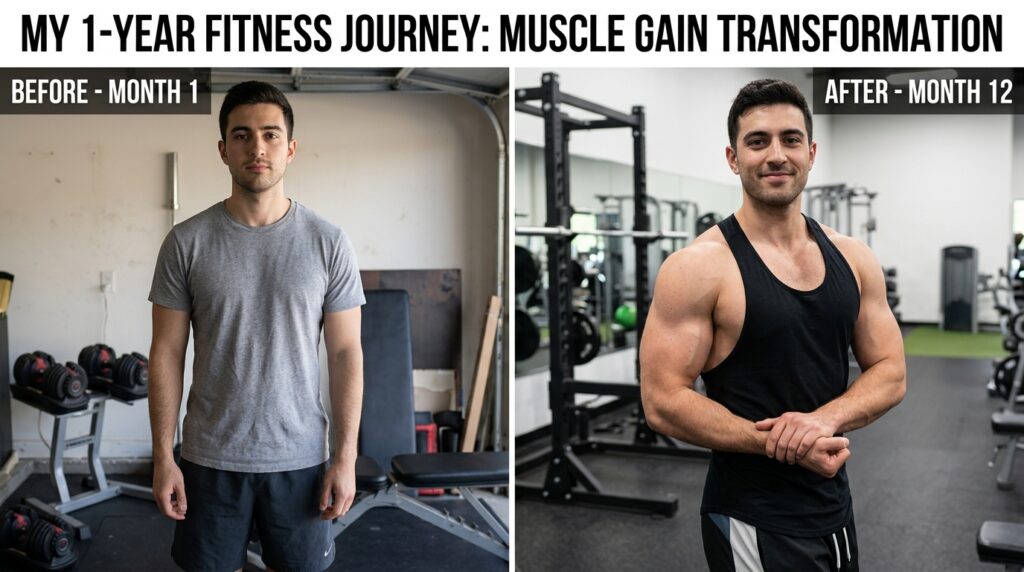
MONTH 1–2
- learning phase
- minor strength gains
MONTH 3–6
- visible muscle change
- better physique structure
MONTH 6–12
- clear transformation
- body recomposition possible
YEAR 1+
- strong muscular base
- long-term athletic physique
REALITY CHECK
Transformation is not dramatic daily; it is accumulated weekly
External Links Related to Muscle Building Guide
The following references and answers are based on established fitness science and widely accepted research on muscle building, training adaptation, nutrition, and recovery principles.
- https://www.ncbi.nlm.nih.gov/pmc/articles/PMC6680710/
- https://www.ncbi.nlm.nih.gov/pmc/articles/PMC5477153/
- https://www.acsm.org/education-resources/trending-topics-resources/resource-library/detail?id=8f7b1f4a-1f2d-4a5f-9c2a-1d3b7e9c0a11
- https://www.healthline.com/health/how-to-build-muscle
- https://www.sleepfoundation.org/physical-activity/athletes-and-sleep
FREQUENTLY ASKED QUESTIONS (FAQS)
1. How long does it take to build noticeable muscle?
Muscle building is a slow biological process. Most beginners start noticing visible changes in 8–12 weeks, but this depends on consistency in training, nutrition, and recovery.
However, real transformation becomes clear after 3–6 months, and significant physique changes usually take 6–12 months of consistent effort.
Important truth: Muscle growth is cumulative, not instant.
2. Can I build muscle without going to the gym?
Yes, muscle can be built without a gym using bodyweight exercises like push-ups, squats, pull-ups, and resistance bands.
However, gym training is more effective because
- It allows progressive overload more easily
- Heavier resistance can be applied
- muscle groups can be isolated better
So home workouts work, but the gym accelerates results.
3. How much protein do I really need daily?
Protein requirement depends on body weight and activity level.
Standard range:
1.6 g to 2.2g per kg body weight
For example:
- 60kg person → 100–130g protein/day
- 70kg person → 110–150g protein/day
Protein must be consistent daily for best results.
4. Is sleep really important for muscle growth?
Yes — sleep is one of the most important factors in muscle building.
During deep sleep:
- muscle repair increases
- Growth hormone is released
- The nervous system recovers
- fatigue is reduced
Without proper sleep, muscle growth slows down significantly, even with a perfect diet and training.
5. Do I need supplements to build muscle?
No, supplements are NOT necessary.
They are optional tools that can help fill nutritional gaps.
- Whey protein = convenience
- Creatine = performance support
- Others = minor impact
Real muscle growth comes from:
training + nutrition + recovery
NOT supplements.
6. Why am I not gaining muscle even though I go to the gym?
This is one of the most common problems.
Main reasons include:
- no progressive overload
- inconsistent training
- low protein intake
- not eating enough calories
- poor sleep
- random workout structure
The gym alone is not enough; the system matters.
7. What is the best training split for muscle growth?
There is no single “perfect” split, but the most effective systems are:
- Push, Pull, Legs (best overall balance)
- Upper/Lower split (intermediate level)
- Full body workout (beginners)
The key is not the split; it is consistency and progression.
8. Why do beginners gain muscle faster?
Beginners experience something called “newbie gains.”
This happens because:
- The body is not adapted to resistance yet
- muscle fibers respond quickly to new stress
- Neurological adaptation is rapid
This phase usually lasts 3–6 months.
CONCLUSION
Muscle building is often misunderstood as a simple gym-based activity, but in reality, it is a structured biological adaptation system that requires time, discipline, and consistency across multiple factors.
After covering all 6 parts of this guide, one truth becomes extremely clear:
Muscle growth is not created by one factor; it is created by the interaction of training, nutrition, recovery, and long-term consistency.
1. TRAINING: THE GROWTH SIGNAL
Training is the first step in muscle building.
Its role is NOT to build muscle directly, but to create a signal for adaptation.
We learned that:
- muscles grow only when stressed
- Progressive overload is essential
- Structured training beats random workouts
- Compound movements build the most mass
- Isolation exercises refine shape
Without progressive overload, the body has no reason to grow.
If training does not increase in difficulty over time, muscle growth eventually stops.
2. NUTRITION: THE BUILDING MATERIAL
Nutrition is the second pillar and provides everything your body needs to rebuild muscle tissue.
We covered that.
- A calorie surplus is required for growth
- Protein is the primary building block
- Carbohydrates fuel performance and recovery
- Fats support hormones and long-term health
- Supplements are optional, not mandatory
Without proper nutrition, training damage cannot be repaired effectively.
Even perfect workouts will fail if the body is under-fueled.
3. RECOVERY: THE ACTUAL GROWTH PHASE
Recovery is where muscle growth actually happens.
We learned that:
- Muscle fibers repair during rest
- Sleep is the most powerful recovery tool
- Overtraining slows or stops progress
- Stress and fatigue directly impact growth
- Rest days are necessary for adaptation
Without recovery, training becomes destructive instead of productive.
This is the most ignored part by beginners, yet one of the most important factors in long-term progress.
4. WHY MOST PEOPLE FAIL
Across all sections, one pattern is clear:
Most people fail not because they don’t train, but because they
- lack structure
- change programs too often
- do not track progress
- eat inconsistently
- sleep poorly
- expect fast results
Muscle building does not reward short-term effort.
It rewards long-term consistency.
5. THE ADAPTATION PRINCIPLE
The human body is designed to adapt.
This means:
- It grows stronger when challenged
- It stops growing when the challenge disappears
- It becomes efficient at repeated stress
That is why progression is necessary in the following:
- weights
- reps
- intensity
- recovery quality
- nutrition consistency
Without progression, adaptation stops — and so does muscle growth.
6. REALISTIC EXPECTATIONS
One of the biggest fitness mistakes is unrealistic expectations.
Muscle building follows a slow but predictable timeline:
- initial strength gains in weeks
- visible changes in months
- transformation in 6–12 months
- long-term physique development in years
There are no shortcuts — only systems.
FINAL MESSAGE
If everything from this guide is summarized into one principle, it is this:
Muscle building is not about doing everything perfectly for a few days.
It is about doing the right things consistently for a long time.
Training provides the signal.
Nutrition provides the material.
Recovery builds the result.
And consistency connects everything.
FINAL WORD
If you truly understand this system and apply it without constantly changing direction, your body will inevitably adapt, grow, and transform over time.
Not quickly.
Not randomly.
But predictably.
Because muscle building is not guesswork.
It is biology + structure + time.